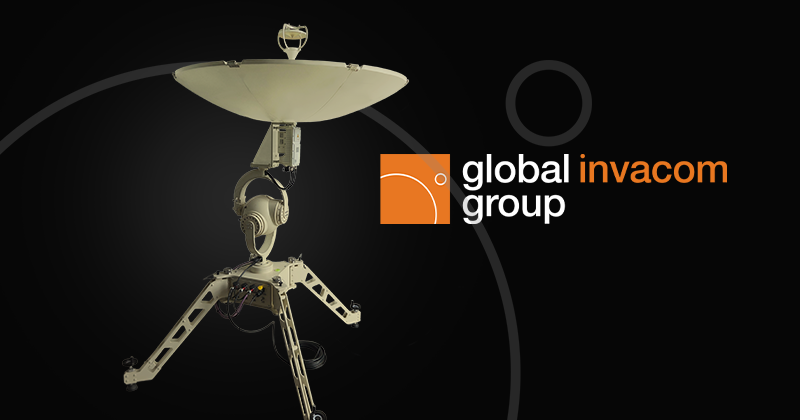
Delivering Enhanced Flexibility
As satcom has evolved to meet the increased demand for connectivity and the diverse needs of users, simplicity and flexibility has become increasingly important. The rigid fixed function satcom hardware of the past is gradually being replaced by technology that is intuitive to operate and enables much greater flexibility. From software-defined satellites and multi-orbit/multi-band constellations, through to ground equipment such as antennas, terminals and modems, the new generation of satcom technology on the market is all highly flexible and configurable. Transceivers, which offer a flexible alternative to traditional Low Noise Block Downconverters (LNB) and Block Upconverters (BUC), fit neatly into this, so it’s hardly surprising that they’re also growing in popularity.
Why Transceivers Are Gaining Ground
Transceivers have evolved, with new designs into smaller, lighter compact satcom terminal must have technology, which provide both uplink and downlink capability in one compact device that attaches directly to the antenna. Transceivers at Ka band are now available with the RF power output required for the majority of terminal use cases and the compact tight integration with the antenna means better G/T or the ground system. This brings a number of tangible benefits to users. Instead of having to transport and fit separate LNBs and BUCs, plus the cabling and mounting hardware they each require, only one unit is needed. This unit also includes an integrated polarizer and OMT (Orthomode Transducer) which enables polarity switching to be internal and automatic.
Having a single unit that handles the functions of the LNB and BUC brings immense value to those working in the field. Not only does less equipment need to be transported to the site, but with one single integrated unit, assembling the antenna is also quicker and easier. These advantages are particularly valuable in the aftermath of disasters or extreme weather events, where connectivity needs to be established quickly, often in remote regions. Using a transceiver means less hardware to transport, fewer points of failure and a faster path to establishing connection.
Transceivers also align well with strict SWAPC (size, weight, power and cost) expectations. Their compact form lowers weight; their integrated design reduces power draw; and having one component cuts down on setup complexity.
Key Benefits
The technical gains are also worth noting. By integrating the receive and transmit paths, transceivers reduce losses through the RF chain. Transceiver manufacturers have pushed performance levels to the point where they can meet the needs of most terminal applications, including many that operate in LEO and MEO. Some units are now delivering power levels that were once the domain of larger BUCs. Global Invacom’s XRJ transceiver, for example, offers 25 watts of linear power (50W saturated power), which places it at the high end of the market. The integrated design ensures that key RF metrics such as isolation and axial ratio remain as good as if not better than a discreet system. Additionally, transceivers can also cover all frequency bands, which further adds to the flexibility they offer.
Additionally, because one unit replaces several discreet products, procurement and testing are also more straightforward. Using transceivers can also deliver cost benefits. A single integrated device simplifies assembly and reduces the number of parts to stock or replace. Added to that, when only one vendor is involved instead of multiple vendors, in the event of a problem, troubleshooting is simplified. Reliability is another important factor to consider. Transceivers have fewer components and fewer interconnects that traditional setups with discreets which can translate to a lower mean time between failures. This is particularly welcome in remote areas and situations where equipment may need to run for long periods with minimal support.
More Choice, More Flexibility
None of this means that traditional LNBs and BUCs no longer have a place in satcom, but rather the availability of transceivers gives users more flexibility and choice over installation and operation.
There are still plenty of use cases where there may be a need to configure discreets separately or where there may be a need for very high-power components, which will make LNBs and BUCs the right choice. Some users also prefer the familiarity of discreets and the comfort of hardware they have used for years. However, the advantages that transceivers bring, alongside the flexibility they add, is leading many satcom companies to reconsider their default approach of using discreets. Government and defence users have been early adopters of transceivers because their missions are often constrained by weight limits, short deployment windows and tight budgets.
The decision between discreets and a transceiver ultimately comes down to application. Each has strengths and limitations. What is becoming clear, though, is that the industry is entering a period where the variety of use cases is expanding rapidly. Environmental monitoring, tactical communications, mobile broadband, connected transport and many other sectors all have their own pressures and their own operational complexities. The availability of more flexible satcom technology allows satcom to better meet the needs of its customers.
The satcom sector has proved itself to be highly adept at evolving to meet customer needs and changing market demands, and the availability of technology that delivers enhanced flexibility is a big part of that. Transceivers fit neatly into this because they are flexible, configurable and offer a practical path to lighter, simpler and more compact terminals.
To find out more about how transceivers may help you to achieve greater flexibility, get in touch with Global Invacom.