Squeezing All the Juice From Your Earth Observation Ground Segment
There’s been a massive increase in the use of Earth Observation (EO) applications and services in recent years. This has led to more and more EO satellites being launched, and as a result, there’s a growing need for suitable ground station networks that are geographically diverse and able to task the satellite and download data efficiently.
For EO and ground segment operators, the challenge goes further than just sourcing the ground segment solution that provides the required capabilities in terms of RF performance. This part is actually relatively straight forward because antennas are manufactured to minimum performance standards, so while there are some that boast special capabilities, in general, RF performance does not vary hugely between one antenna and the next.
Rather, the bigger challenge is in getting the ground station up and running so it can start downloading data as quickly as possible, reducing installation costs and minimising costs throughout the entire life cycle, and maximising utilisation. Let’s explore each of these in more detail.
Reducing time to deploy
The sooner the ground segment solution is in place, the quicker it can acquire, deliver data and switch to the next pass. There are several things that operators can do to reduce the time to deploy. Rather than buying in separate components to build a unique solution which is generally time consuming, a faster alternative is to source a complete, ready-to-go solution.
Installation options are another important consideration. Traditional installations often rely on substantial civil engineering work, from digging and pouring reinforced foundations to ensuring the antenna is perfectly level and structurally stable. This requires the use of contractors and heavy equipment and is generally costly and time consuming. Additionally, this type of installation is generally classed as a permanent structure so will usually require local planning permits.
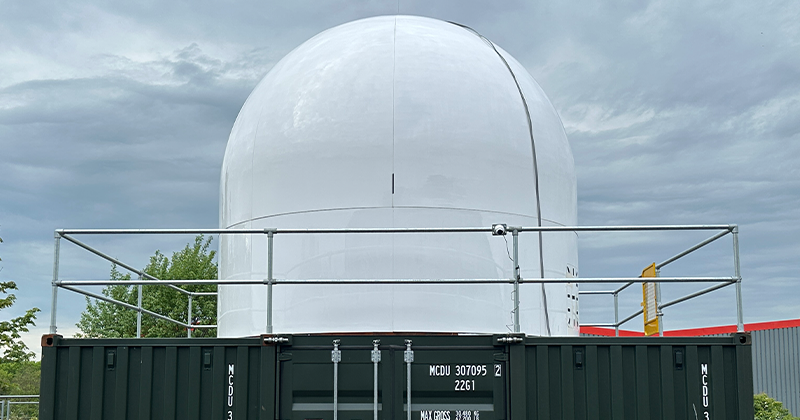
This is where more flexible installation approaches become important. Options such as roof mounted systems or installations on preprepared concrete pads reduce the amount of groundwork needed, thereby reducing time and costs to install. Container-based solutions offer another approach featuring a pre-integrated system. Instead of building everything on site, the core infrastructure arrives ready to deploy, which reduces civil works and shortens the time between delivery and operation.
Ease of integration is another contributing factor, if operators can’t easily integrate a new terminal into the existing network, this is going to add significant time (and cost) to the installation.
Minimising costs over the entire lifetime
While the right installation approach and sourcing a solution that enables easy integration can significantly reduce initial costs, steps also need to be taken to reduce direct and indirect costs that incur over the lifecycle of a ground station solution. This includes ensuring the solution installed is extremely reliable so that downtime for issues and maintenance is minimised.
Having this reliability along with the ability to operate the ground station remotely are both essential because EO ground stations are almost always sited in remote locations which make physical operation and maintenance costly and logistically challenging.
At the same time, it’s also worth ensuring that if maintenance is required, low-cost, easy-to-source common spares can be used. A system that requires frequent specialist intervention can create additional operational costs and reduce the availability of the ground station. Accessible components, common parts and straightforward replacement procedures can make routine maintenance easier and reduce the need for specialist call-outs.
Achieving maximum utilisation
Operators naturally want to get as much use and value as possible out of the ground segment solution. This can be achieved through a range of measures such as maximising the number of satellite passes the ground station can support, through efficient scheduling, by minimising downtime, and by using the ground station across multiple customers or missions.
An efficient ground station will optimise data per pass, and passes per day to maximise data yield. Over the course of the ground stations lifetime, these gains really add up. Flexibility is also essential because a configurable ground segment solution will be able to serve different customer requirements, thereby providing more value over its life cycle than a rigid non-configurable solution. This is particularly true when it comes to defence where satellite imagery is used for Intelligence, Surveillance and Reconnaissance (ISR). In these applications, terminals may need to support a broad range of missions, often with different RF capabilities and baseband units.
Scalability is another important consideration. Operators need to be able to expand their ground infrastructure without creating unnecessary complexity. New terminals may need to be added quickly at existing or new sites, so again ease of integration is particularly important.
For GSaaS providers in particular, the ability to add capacity and manage terminals as part of a wider network can be important as customer requirements change. Ground infrastructure needs to support that growth without requiring every new deployment to be treated as a bespoke project.
Global Invacom’s S/X band Earth Observation Ground Station
Global Invacom’s TerraLink 370EO is a deployable 3.7m Earth Observation ground station delivering tactical data acquisition and rapid mission deployment. It enables users to seamlessly gather reliable data, no matter the orbit, environment, or scale.
The GI TerraLink 370EO is the culmination of more than 30 years designing and building antennas for a wide range of mission-critical applications. It has been optimised for cost, performance and operations, and ensures stable tracking and uninterrupted data in the most extreme conditions, with significantly enhanced reliability and lower operating costs. The versatile system can be quickly and easily installed on pads, rooftops, frames, or using our innovative containerised version for fast startup on green field sites.
Global Invacom Group Limited and Ground Station-as-a-Service (GSaaS) provider, eNexus Space Data have recently announced the installation of a series of these EO ground stations, the first of which will be sited in the north of Scotland, the second in Alaska, and the third in the southern hemisphere. Under the partnership, eNexus Space Data, will use the ground stations to provide EO-as-a-service, gathering data from LEO constellations.
For more information about Global Invacom’s EO ground station or the planned deployment of EO ground stations with eNexus Space Data, get in touch.